
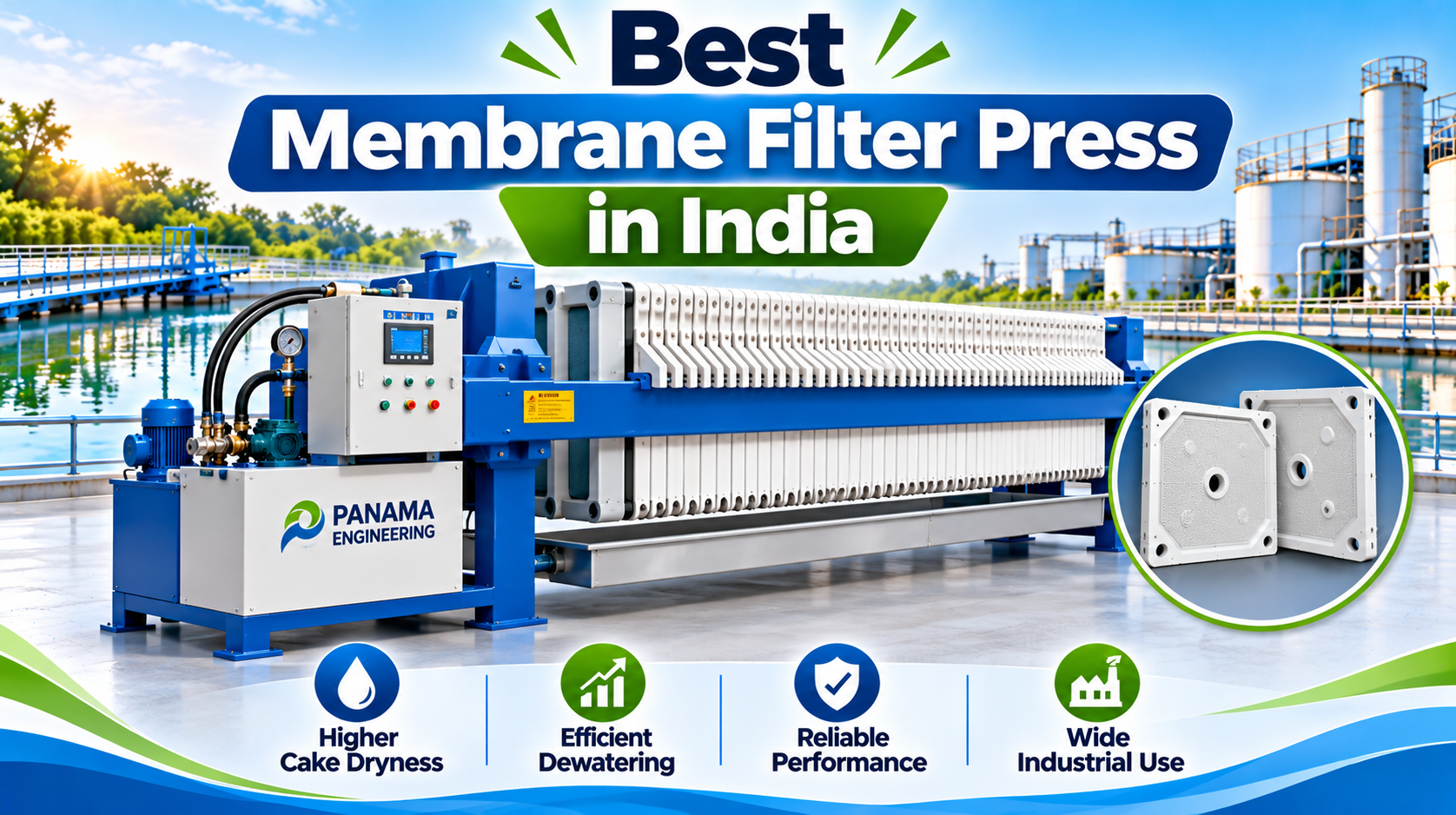
Best Membrane Filter Press in India: Complete Guide to Features, Benefits, Applications & Selection
Industrial filtration plays a critical role in manufacturing, wastewater treatment, chemical processing, mining, pharmaceuticals, and many other industries. As businesses look for ways to improve filtration efficiency, reduce sludge moisture, and optimize operating costs, advanced filtration equipment has become increasingly important.
Choosing the best membrane filter press in India can help industries achieve more effective solid-liquid separation while improving process control and filter cake handling.
A membrane filter press combines conventional pressure filtration with an additional membrane squeezing stage. This makes it particularly useful for applications where lower residual cake moisture is an important operational requirement.
However, selecting the right equipment involves more than choosing a machine based on price or capacity.
Businesses must evaluate slurry characteristics, filtration pressure, membrane design, automation requirements, chemical compatibility, and long-term maintenance costs.
This guide explains how membrane filter presses work, their major advantages, industrial applications, and the important factors to consider when selecting a membrane filter press manufacturer in India.
What Is a Membrane Filter Press?
A membrane filter press is an industrial solid-liquid separation machine that uses specially designed membrane filter plates to separate suspended solids from liquid.
The equipment operates through two main stages: initial pressure filtration and additional filter cake squeezing.
During initial filtration, slurry enters the filter chambers, where liquid passes through the filtration medium and solids accumulate to form a filter cake.
After this stage, flexible membranes expand under controlled pressure to compress the filter cake and remove additional liquid.
In simple terms, a membrane filter press is a filtration machine designed to produce a drier filter cake by applying additional squeezing pressure after conventional filtration.
This technology is commonly used in industrial applications where efficient dewatering, controlled moisture content, and reliable filtration performance are essential.
Main Components of a Membrane Filter Press
A typical membrane filter press consists of several important components:
- Membrane filter plates: Create filtration chambers and provide the additional squeezing mechanism.
- Filter press frame: Supports the plate assembly and operating loads.
- Hydraulic closing system: Keeps the plates securely compressed during filtration.
- Slurry feed pump: Transfers slurry into the filtration chambers.
- Filtration medium: Retains solids while allowing liquid to pass through.
- Membrane squeezing system: Supplies a controlled medium to expand the membranes.
- Filtrate collection system: Collects and discharges separated liquid.
- Control system: Monitors and manages operating sequences, depending on the automation level.
Each component contributes to overall filtration efficiency and equipment reliability.
How Does a Membrane Filter Press Work?
A membrane filter press uses pressure filtration followed by a controlled cake-squeezing process.
The additional squeezing stage distinguishes membrane filter presses from conventional recessed chamber filter presses.
Step 1: Slurry Feeding
The filtration cycle begins when slurry is pumped into the filter press chambers.
Slurry generally contains suspended solids mixed with liquid.
As slurry enters the chambers, pressure causes liquid to pass through the filter medium while solids remain inside.
Step 2: Filter Cake Formation
During filtration, suspended solids accumulate on the filter medium and gradually form a filter cake.
The separated liquid, called filtrate, flows through drainage channels and exits the equipment.
As the cake develops, filtration resistance increases.
Step 3: Membrane Squeezing
After initial filtration, the membrane squeezing stage begins.
A suitable squeezing medium, such as water or compressed air where permitted by the equipment design, is introduced behind the flexible membranes.
The membranes expand and compress the filter cake.
This mechanical squeezing helps remove additional liquid.
Step 4: Additional Dewatering
As the filter cake is compressed, more liquid passes through the filtration medium.
The amount of moisture removed depends on the slurry composition, cake compressibility, squeezing pressure, and squeezing duration.
Step 5: Pressure Release and Cake Discharge
Once the squeezing stage is complete, membrane pressure is released.
The filter press opens, allowing the dewatered cake to be discharged.
The equipment can then begin another filtration cycle.
Quick Answer: A membrane filter press improves dewatering by combining pressure filtration with an additional squeezing stage that removes liquid from the formed filter cake.
Key Features of the Best Membrane Filter Press in India
Selecting a high-quality membrane filter press requires careful attention to equipment construction, performance, and operating requirements.
1. Advanced Membrane Squeezing Technology
The defining feature of a membrane filter press is its flexible membrane system.
This technology provides additional compression after the initial filtration stage, potentially reducing residual cake moisture.
2. Durable Industrial Construction
Industrial filter presses must withstand repeated filtration cycles, hydraulic closing forces, and demanding operating environments.
A suitable machine should feature a properly engineered frame, reliable hydraulic components, and filtration plates compatible with the process.
3. Efficient Solid-Liquid Separation
Membrane filter presses are designed to separate solids from liquid while supporting effective cake formation and additional dewatering.
Filtration performance depends on the slurry and operating conditions.
4. Flexible Automation Options
Depending on the equipment configuration, membrane filter presses may include:
- Automated plate opening
- Hydraulic closing controls
- Automatic pressure monitoring
- Programmable filtration cycles
- Automatic cake discharge assistance
- Process monitoring and alarms
Automation can help reduce manual intervention and improve operational consistency.
5. Chemical Compatibility
A membrane filter press should be designed using materials suitable for the chemicals present in the process.
Plate materials, membranes, seals, and other wetted components must be evaluated for chemical and temperature compatibility.
6. Reliable Pressure Control
Feed pressure and membrane squeezing pressure are separate operating parameters.
Both must remain within the manufacturer's specified limits.
Accurate pressure control is essential for safe and consistent filtration.
Major Benefits of Using a Membrane Filter Press
Membrane filter presses offer several potential advantages for industrial filtration processes.
Improved Filter Cake Dryness
One of the primary benefits is the ability to remove additional liquid from the filter cake.
This can improve cake consistency and reduce residual moisture compared with conventional pressure filtration under suitable conditions.
Reduced Sludge Handling Costs
Drier sludge may reduce the amount of wet material requiring transportation, storage, or disposal.
The actual savings depend on disposal charges, solids characteristics, and equipment operating costs.
Potentially Shorter Filtration Cycles
In certain applications, membrane squeezing allows operators to achieve the required cake moisture without extending the initial filtration stage.
This can improve filtration throughput.
However, the complete cycle time must include feeding, squeezing, pressure release, plate opening, and cake discharge.
Better Cake Handling
A drier filter cake is often easier to transport and process.
This is particularly useful for industries that require consistent cake characteristics.
Improved Process Control
Operators can adjust squeezing pressure and duration within the equipment's specified operating range.
This provides greater control over the final cake moisture.
Potential Reduction in Downstream Drying
When additional mechanical dewatering reduces the amount of moisture that must be removed through thermal drying, overall energy requirements may decrease.
The benefit should be evaluated through process-specific testing.
Industrial Applications of Membrane Filter Press Machines
Membrane filter presses are used in industries that require efficient solid-liquid separation and sludge dewatering.
Industry
Common application
Potential benefit
Wastewater Treatment
ETP and STP sludge dewatering
Reduced sludge moisture
Chemical Industry
Chemical slurry separation
Improved cake dewatering
Pharmaceutical Industry
Process filtration
Controlled solid-liquid separation
Mining Industry
Mineral slurry dewatering
Improved solids handling
Food Processing
Product and by-product filtration
Better moisture control
Dyes and Pigments
Pigment slurry filtration
Improved cake consistency
Ceramics
Ceramic slurry dewatering
More consistent processing
Metal Processing
Industrial sludge filtration
Reduced liquid content
Membrane Filter Press for Wastewater Treatment
Wastewater treatment facilities often generate sludge that requires dewatering before disposal or further processing.
Membrane filter presses can help reduce sludge moisture and improve cake handling.
They are particularly useful where disposal costs are influenced by the amount of wet sludge produced.
Membrane Filter Press for Chemical Industries
Chemical manufacturing frequently involves separating solid products, by-products, and suspended particles from process liquids.
Membrane filtration may improve product recovery and cake dewatering when properly matched to the process.
Membrane Filter Press for Mining and Minerals
Mining operations process large quantities of mineral slurry.
Membrane filter presses can help recover solids and reduce the moisture content of mineral filter cakes.
Membrane Filter Press for Pharmaceutical Industries
Pharmaceutical applications may require carefully selected construction materials, validated cleaning procedures, and appropriate process controls.
Equipment selection should account for applicable quality and product-contact requirements.
Membrane Filter Press for Food Processing
Food processing applications may use membrane filtration for suitable product or by-product separation processes.
Materials and equipment construction must meet the relevant hygiene and product-contact requirements.
Membrane Filter Press vs Conventional Filter Press
Understanding the differences between membrane and conventional chamber filter presses is essential before purchasing filtration equipment.
Feature
Membrane Filter Press
Conventional Chamber Filter Press
Filtration method
Pressure filtration and membrane squeezing
Primarily pressure filtration
Additional squeezing
Yes
No
Cake moisture
Potentially lower
Depends on feed filtration
Equipment complexity
Higher
Generally lower
Initial investment
Typically higher
Typically lower
Process control
Additional squeezing controls
Conventional pressure controls
Maintenance
Includes membrane system
Generally simpler
Suitable applications
Higher dewatering requirements
Standard filtration requirements
Which Is Better: Membrane Filter Press or Chamber Filter Press?
A membrane filter press is generally worth considering when lower residual cake moisture is a priority.
A conventional chamber filter press may be more economical when standard pressure filtration already meets the required cake dryness and throughput.
The best choice depends on slurry characteristics, operating conditions, production requirements, and total ownership costs.
Types of Membrane Filter Press Machines Available in India
Different membrane filter press configurations are available for industrial filtration applications.
Manual Membrane Filter Press
Manual configurations require greater operator involvement during filtration and cake discharge.
They may be suitable for smaller operations where automation is not a major requirement.
Semi-Automatic Membrane Filter Press
Semi-automatic systems combine selected automated functions with manual operating steps.
They can provide a balance between equipment investment and operational convenience.
Automatic Membrane Filter Press
Automatic membrane filter presses incorporate additional automation for selected functions such as plate movement, pressure control, and cycle management.
They are often considered for applications involving frequent filtration cycles or higher production requirements.
High-Pressure Membrane Filter Press
High-pressure configurations are designed for specific applications requiring elevated operating pressures.
Pressure ratings must be verified against the complete equipment design and manufacturer's specifications.
Customized Membrane Filter Press
Customized machines may be configured according to slurry characteristics, required capacity, plate dimensions, membrane materials, and automation requirements.
How to Choose the Best Membrane Filter Press in India
Selecting the right equipment requires a detailed understanding of your filtration process.
1. Evaluate Slurry Characteristics
Start by examining the material being processed.
Important factors include:
- Solids concentration
- Particle size
- Slurry viscosity
- Chemical composition
- Operating temperature
- Cake compressibility
- Required filtrate quality
These factors influence filtration performance and equipment selection.
2. Determine Filtration Capacity
Calculate the volume of slurry that must be processed within the available operating period.
Consider daily production requirements, batch size, filtration cycle time, and anticipated future capacity.
3. Define the Required Cake Moisture
The desired residual moisture content is an important selection factor.
Different industries have different cake dryness requirements.
For example, wastewater treatment facilities may prioritize reducing disposal costs, while chemical manufacturers may require a specific cake consistency for downstream processing.
4. Check Pressure Specifications
Verify the maximum allowable feed pressure and membrane squeezing pressure.
Never assume that all membrane filter presses operate at the same pressure.
The correct operating limits depend on the machine, plate construction, membrane material, and manufacturer specifications.
5. Select the Right Membrane Plates
Membrane filter plates are essential components of the filtration system.
Important selection criteria include plate dimensions, material compatibility, membrane design, pressure rating, and chamber capacity.
Explore membrane filter plate solutions to understand available plate configurations.
6. Compare Automation Requirements
Automation can improve process consistency and reduce manual work, but it also affects equipment investment and maintenance requirements.
Choose an automation level that matches your production volume, staffing, and operating conditions.
7. Evaluate Total Ownership Costs
Instead of focusing only on the purchase price, compare:
- Equipment investment
- Installation requirements
- Energy consumption
- Maintenance costs
- Membrane replacement costs
- Operating labor
- Cake disposal costs
- Expected equipment life
A higher initial investment may be justified when the equipment delivers measurable operating benefits.
8. Choose an Experienced Manufacturer
A reliable membrane filter press manufacturer should provide technical specifications, equipment configuration guidance, and suitable support.
Where possible, request slurry testing or performance data from comparable applications.
Membrane Filter Press Selection Checklist
Selection factor
What to verify
Filtration capacity
Required slurry processing volume
Plate size
Suitable filtration area
Membrane design
Fixed or replaceable membrane
Operating pressure
Feed and squeezing pressure ratings
Construction materials
Chemical and temperature compatibility
Automation
Manual, semi-automatic, or automatic
Cake moisture
Required residual moisture
Maintenance
Inspection and replacement requirements
Manufacturer support
Technical guidance and documentation
Why Consider Panama Engineering for Membrane Filter Press Solutions in India?
When searching for a membrane filter press manufacturer in India, it is important to evaluate the manufacturer's product range, technical capabilities, and suitability for your application.
Panama Engineering provides industrial filtration equipment and filter press components for solid-liquid separation applications.
The company offers membrane filtration solutions intended for different industrial processing requirements.
Membrane Filter Press Solutions
Membrane filter presses are designed to support effective cake dewatering through conventional filtration followed by membrane squeezing.
Industrial Filter Press Plates
The company also offers filtration plate solutions for industrial applications.
Explore its filter press plate range to learn about plate designs and configurations.
Filtration Equipment Options
Different industrial applications require different filtration capacities, plate arrangements, and operating systems.
Businesses should evaluate available filter press equipment according to their process requirements.
Technical Enquiries
For equipment specifications, product compatibility, and application-specific requirements, contact Panama Engineering.
Providing detailed slurry characteristics and performance requirements can help the technical team assess suitable equipment options.
Membrane Filter Press Price in India: What Determines the Cost?
The price of a membrane filter press in India varies depending on equipment specifications and industrial requirements.
Major Factors Affecting Price
1. Filtration capacity: Larger machines generally require more filtration area and supporting equipment.
2. Plate size and quantity: The number and dimensions of membrane plates influence overall equipment cost.
3. Automation level: Automatic systems typically require additional controls and mechanical components.
4. Construction materials: Specialized materials may increase manufacturing costs.
5. Pressure rating: Higher-pressure configurations may require stronger structural components and specialized systems.
6. Customization: Application-specific modifications can affect pricing.
7. Accessories: Pumps, control panels, piping, and other accessories may be included or quoted separately.
How to Get an Accurate Membrane Filter Press Quotation
Before requesting a quotation, prepare the following information:
- Type of slurry
- Solids concentration
- Required processing capacity
- Operating temperature
- Chemical composition
- Desired filter cake moisture
- Available utilities
- Preferred automation level
These details help manufacturers recommend suitable configurations.
Maintenance Tips for Membrane Filter Press Machines
Regular maintenance supports reliable equipment operation and helps reduce avoidable downtime.
Inspect Membrane Plates
Check membranes for cracks, swelling, tears, and other signs of deterioration.
Monitor Hydraulic Systems
Inspect hydraulic components and ensure the closing system operates within specified limits.
Maintain Proper Pressure
Do not exceed the manufacturer's recommended filtration or squeezing pressure.
Clean Drainage Channels
Blocked filtrate passages can reduce filtration performance.
Check Plate Alignment
Proper plate alignment helps maintain sealing and distribute mechanical loads.
Monitor Filtration Performance
Changes in cycle time, filtrate clarity, leakage, or cake moisture may indicate maintenance requirements.
Follow Manufacturer Guidelines
Use the manufacturer's recommended cleaning, inspection, and replacement procedures.
People Also Ask: Best Membrane Filter Press in India
What is the best membrane filter press in India?
The best membrane filter press in India is one that matches the required filtration capacity, slurry characteristics, operating pressure, cake moisture target, and automation requirements. Equipment selection should be based on technical compatibility and total ownership costs.
What is the main advantage of a membrane filter press?
The main advantage is additional cake squeezing after initial filtration. This can reduce residual moisture and improve filter cake handling in suitable applications.
How does a membrane filter press work?
A membrane filter press first separates solids and liquids through pressure filtration. Flexible membranes then expand to compress the filter cake and remove additional liquid before cake discharge.
Which industries use membrane filter presses?
Membrane filter presses are used in wastewater treatment, chemical processing, mining, pharmaceuticals, food processing, ceramics, dyes, pigments, and other industrial filtration applications.
Is a membrane filter press better than a chamber filter press?
A membrane filter press may be preferable when lower cake moisture is required. A chamber filter press may be more economical for applications where conventional pressure filtration provides sufficient performance.
What is the price of a membrane filter press in India?
Prices depend on filtration capacity, plate dimensions, membrane design, automation, pressure rating, materials, and customization. Manufacturers generally provide quotations based on specific technical requirements.
Can a membrane filter press reduce sludge disposal costs?
It may reduce sludge disposal costs by removing additional liquid and lowering the wet mass requiring disposal. Actual savings depend on sludge characteristics, disposal arrangements, and equipment operating costs.
What is the difference between a membrane filter press and a conventional filter press?
A membrane filter press includes an additional squeezing stage that compresses the filter cake. A conventional chamber filter press relies primarily on feed pressure for dewatering.
How do I choose a membrane filter press manufacturer in India?
Compare technical specifications, product compatibility, manufacturing capabilities, application support, maintenance requirements, and overall operating costs. Request process-specific guidance before purchasing.
Conclusion: Find the Best Membrane Filter Press in India for Your Industry
Choosing the best membrane filter press in India is an important step toward improving industrial filtration performance, controlling filter cake moisture, and optimizing solid-liquid separation.
A properly selected membrane filter press can provide effective dewatering, improved cake handling, and greater process flexibility.
However, the most suitable machine depends on the nature of the slurry, required filtration capacity, pressure limits, material compatibility, and operating requirements.
Businesses should compare equipment specifications carefully and consider both initial investment and long-term operating costs.
For industries looking for membrane filter press solutions, Panama Engineering offers filtration equipment and components for different industrial requirements.
Looking for the right membrane filter press for your application?
Contact Panama Engineering to discuss your filtration requirements, equipment specifications, and suitable membrane filter press configurations.
Explore Filter Press Solutions
Continue your research with our filter press machines, filter press plates and technical enquiry pages.
Send Your Requirement